

At some point, every pool in the Algarve needs a new finish. For many homeowners considering recycled glass pool tiles Algarve, the timing often becomes obvious. Ours included, back when we started the company. Ten or twelve years of summer UV, salt working its way into the grout, and then you notice it one winter morning: a crack along the waterline, or that brownish stain that no amount of scrubbing will budge.
At that point you have two options. Same again, or something worth the disruption.
We fit SQ Mosaic recycled glass tiles in pools across the Algarve and we keep choosing them. Not because they are fashionable. Because nothing else we have worked with holds up better in this climate.
Why Glass Mosaic Survives the Algarve
People who move here from the UK do not always appreciate what our summers do to building materials until they have lived through a few.
Between Albufeira and Quarteira, if your pool faces south, it is taking eight or nine hours of direct sun a day in July. Try walking across the stone terrace barefoot at lunchtime. You will not do it twice.
Then winter comes and night temperatures around Loulé drop close to zero. Do that for a decade, forty degrees then near-freezing then forty again, and conventional finishes give up. Ceramic is the usual culprit. It lets in tiny amounts of moisture, barely measurable, but enough. Cold nights make that moisture swell. Hot days shrink it back. Eight years of that and tiles start popping off at the edges. We have lost count of how many ceramic retiling jobs we have done across the central Algarve because of exactly this.
Glass mosaic absorbs zero water. None. Colour is baked into the glass during firing, not applied as a coating on top, which is why ten years of Algarve sun will not fade it. The tiles carry UNE-EN-ISO certification for chemical resistance and score Class 5 for stain resistance. That is as high as the scale goes.
That matters here specifically. Algarve tap water is hard. Calcium scale builds up stubbornly, people reach for strong descaling products, and a lot of pool finishes suffer under that treatment. Glass mosaic does not.
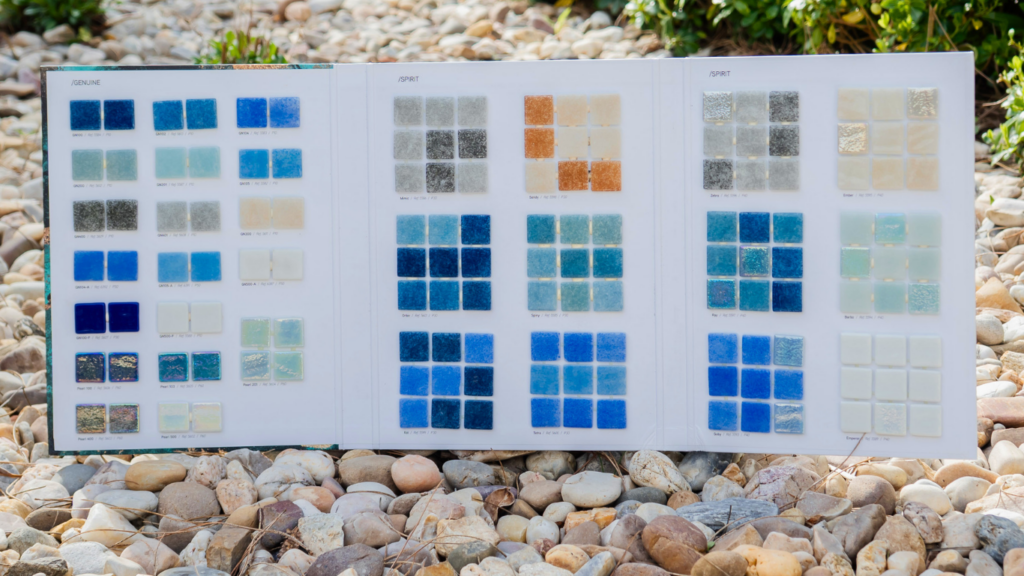
Six Collections (and No, It Is Not All Blue)
We get asked that constantly.
Genuine is the workhorse. Single colour, subtle marbling on each tessera so it does not look flat. Navy through to white, with greens, greys, and sand between. 25mm or 50mm, glossy or anti-slip. The one we install most.
Pearl does something odd with light. The iridescent surface changes depending on the angle of the sun, so the pool looks like a different colour at four in the afternoon than it did at noon. Quinta do Lago, late sun, low angle. That is the moment. We fitted Pearl in a villa near Loulé last year and the owner stood at the pool edge for a full minute before saying anything.
Identity is bold. Organic patterns, multiple colours per tile, four formats including a round mosaic. Some Identity tiles are luminescent. They store daylight and glow faintly after dark. Not garish. More like bioluminescence in shallow water.
Essence borrows its palette from the Atlantic. Five shades of blue-green. Clean, modern, straightforward.
Lithos is marble-effect with a matte finish and visible veining. Available in a hexagonal format called Hex Tech that reads as cut stone. Suits architectural pools, infinity edges, minimal landscaping.
Kubu looks like stone, not glass. Muted colours, matte texture, anti-slip built in. It is what we suggest for the older properties up behind Tavira or around São Brás de Alportel. Cork oaks, dry stone walls, a pool that sits quietly in the landscape rather than shouting at it.
Anti-Slip: Not Optional
Kids run on wet pool decks. Adults do too, usually carrying a cold beer.
SQ Mosaic makes anti-slip variants rated C3/R11 (DIN standard) in Genuine, Lithos, and Kubu. Proper slip-resistant tiles, not just a rougher version of the same product. We specify these on the first three steps of every pool at minimum. Beach entries get full anti-slip coverage.
Put the anti-slip where feet go. Glossy everywhere else.
The Sustainability Bit
We avoid leaning on “sustainability” as a selling point because the word has been stretched thin. But SQ Mosaic’s numbers deserve a straight telling.
All the glass is recycled. Every bit. The kilns run on electricity, some of it from solar panels on the factory roof. Water consumed in manufacturing: zero. Packaging: FSC cardboard. No pledges, no targets, no small print. That is how they make the tiles right now.
Anyone who was here in the Algarve during the drought restrictions of 2023 and 2024 knows water is not a theoretical problem. A pool finish made from landfill-bound glass, manufactured without consuming water, is a tangible improvement over most alternatives. A fact, not a slogan.
What It Costs
Glass mosaic costs more per square metre than cement render or basic ceramic. We would rather say that upfront than let you find out later.
But pool finishes are a twenty-year commitment. Cement render may need redoing after eight or nine years. Basic ceramic can start failing at ten. Glass mosaic, properly installed, still looks right after two decades. The colours do not shift. Nothing lifts at the edges. Over the life of the pool, the maths often favours mosaic.
Not always. It depends on the pool and the collection. But more often than people expect.
If you want a number, get in touch. We quote on actual dimensions and specific tiles, not ballpark figures that turn into fiction later.
Common Questions
How long before I need to retile again?
We know of installations twenty years old still in perfect condition. The material does not degrade from UV or chemicals and absorbs zero water, so there is no mechanism for frost damage or delamination. “Indefinitely” is the honest answer, if the installation is done properly.
Can mosaic go over what I already have?
Depends what state it is in. Tap a few tiles with your knuckle. If they sound hollow, or the grout between them is soft and crumbly, the existing finish has to come off. If everything is solid and level, yes, we can tile over it.
Is glass mosaic slippery?
Glossy finishes can be, which is why SQ Mosaic makes dedicated anti-slip variants tested to C3/R11. We fit these on every set of steps and across any beach entry. Never optional on our jobs.
Will people know it is recycled glass?
Not a chance. The recycled glass gets ground down, mixed with colour, pressed into shape, and fired. The finished tile looks and feels exactly like one made from new glass. Nobody has ever spotted the difference on any pool we have done.
Is a glass mosaic pool harder to maintain?
The opposite. Zero-porosity means algae struggle to attach and calcium scale does not grip the way it does on rougher finishes. Normal pool maintenance. Nothing extra.
