

If you own a pool in the Algarve, the last few years of water headlines will have made uncomfortable reading. Restrictions. Dam levels in the news every week. The Querença-Silves aquifer at less than 20% capacity. The government floating higher tariffs for filling domestic pools. Municipal pools in Loulé shut entirely to conserve supply. In this context, pool water conservation has become an essential topic for pool owners across the region.
This isn’t background noise. It affects your water bill. It affects whether you feel right about topping up the pool in the middle of August when your neighbours are watching their gardens die.
We’ve maintained pools across this region since 2008. We’ve lived through every drought cycle the Algarve has thrown at us, including the worst on record in 2023 and 2024, when 84% of groundwater bodies dropped below the 20th percentile and the government formally declared an alert situation (The Portugal News, February 2024). We are pool people, not hydrologists. But we know what this situation means for anyone with a pool here, and we think it needs saying.
Where Things Stand
A wet 2025 winter brought genuine relief. By November, the Algarve’s six main dams had recovered to 72% capacity. Odelouca and Odeleite, the two biggest, were approaching 80% (The Portugal News, December 2025). José Pimenta Machado, the APA president, confirmed that urban supply is assured for three to four years even in a bad scenario.
But underground, it’s a different picture. The Querença-Silves aquifer, which is the Algarve’s main underground reserve, is still critically low. Pimenta Machado himself said it plainly: “Some sectors say the drought is over, but nothing is over. It’s a temporary situation; we were lucky now, but we have to prepare for the years to come” (The Portugal News, December 2025). The dams look healthy. The aquifers do not. And the aquifers are what most boreholes draw from.
Meanwhile, a €108 million desalination plant is going up in Albufeira. Portugal’s first on the mainland. It should be running by late 2026 or early 2027, producing 16 million cubic metres of drinking water a year (The Portugal News, October 2024). That covers roughly a fifth of the Algarve’s urban consumption, which helps. But climate models still show less rain coming to this region over the next few decades. The plant is a lifeline, not a solution.
So where does this leave pool owners? Cheap, unlimited water in the Algarve is finished. You can absolutely still have a pool. You just can’t pretend it doesn’t use a resource that the whole region is trying to manage better.
How Much Water Your Pool Actually Loses
Most pool owners underestimate evaporation. Badly.
Take a fairly standard Algarve pool: 8 x 5 metres, 40 square metres of surface area. In July and August, with no cover, that pool loses somewhere between 150 and 250 litres a day to evaporation alone. Over a week, your water level drops 5 to 8 centimetres. Over a full summer season, you are looking at 25,000 litres gone. Not leaked. Not splashed out. Just evaporated into the air.
Wind is the accelerant that people forget about. The western Algarve coast, around Sagres, Lagos, parts of Aljezur, gets battered by Atlantic winds that strip moisture off the water surface. We’ve seen pools near Sagres lose water at nearly double the rate of a sheltered pool up in the Loulé hills, and the owners had no idea why their level kept dropping.
Heating makes it worse again. A heated pool evaporates faster because the warm surface creates a bigger temperature gap with the surrounding air. We have clients who run a PolyTropic heat pump all season without a cover, and they’re essentially heating the sky. The pump works harder, the electricity bill creeps up, and the water disappears overnight. A cover fixes this almost completely, but we’ll get to that.
Then there are leaks. We find pools all the time that are losing hundreds of litres a day through a hairline crack in the shell or a weeping pipe joint, and the owner has written it off as “just evaporation.” Our electronic leak detection equipment can tell the difference in one visit. No need to drain the pool.
What Actually Makes a Difference
There’s plenty of advice online about saving water around your pool. Some of it is sensible. Some of it is the pool equivalent of being told to take shorter showers while a burst main floods the road outside. After eighteen years of maintaining pools in this climate, here’s what we know actually moves the needle.
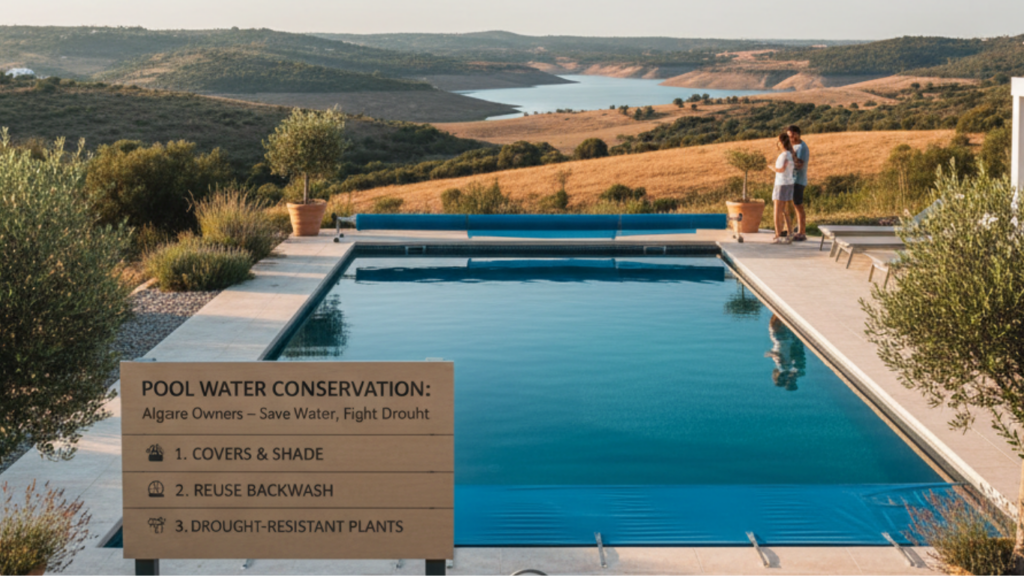
The single biggest thing you can do is cover the pool. Not with a bubble wrap solar cover, which helps a bit, but with a proper slatted automatic cover. A closed slatted cover cuts evaporation by up to 95%. On a pool losing 200 litres a day, that’s 190 litres kept in the water instead of drifting into the Algarve sky. Every day. All season. We install DEL covers in solar and electric versions, and the clients who have them rarely need to think about water level between our visits.
The cover does other things too. It holds heat in the water overnight, so if you run a heat pump, the pump works less. It blocks leaves and dust, which means fewer chemicals and less strain on the filter. Honestly, even without the water argument, a cover makes financial sense in this climate. With the water argument, it’s hard to justify not having one.
After covers, the next priority is leak detection. A pool with a small crack or a weeping pipe fitting can quietly lose more water than evaporation ever would. We’re the only company in Portugal with electronic leak detection equipment. We can pinpoint a leak without draining the pool and without guessing. If your water level is dropping faster than it should, don’t assume it’s evaporation. Get it checked. The longer you leave it, the more water and money you lose.
For owners who aren’t on-site all the time, and that includes a lot of our clients who split their year between the Algarve and the UK or elsewhere, an automatic water level controller makes a real difference. The Pool Level system we install connects to the MyIndygo app on your phone. It monitors the water level around the clock, tops up automatically when it dips, prevents the pump from running dry, and tracks how much water the pool is consuming over time. That last part matters more than people expect. Once you can actually see the numbers, you start paying attention. We’ve had clients completely change how they manage their pool after a month of looking at the consumption data.
Salt chlorination is worth mentioning here too, though it’s less obvious. A salt chlorinator doesn’t reduce evaporation. What it does is keep the water chemistry more stable, which means you’re less likely to end up in a situation where the only fix is to drain half the pool and start again. Pools on manual chlorine dosing swing in and out of balance more often, and every corrective partial drain wastes thousands of litres. We fit Sugar Valley Hidrolife systems, and the consistency they bring to water chemistry has a knock-on effect on water consumption.
Regular maintenance underpins all of this. A neglected pool is a wasteful pool. Algae blooms need shock treatment and sometimes partial draining. A cracked pump housing or a perished valve seal leaks water silently for weeks. Backwashing a dirty filter uses water every time. Our maintenance visits catch these problems early, before they become expensive and wasteful.
One last thing: don’t let anyone talk you into draining your pool for routine maintenance. There are very few situations where a full drain is necessary for a residential pool, and doing it throws away 40,000 to 80,000 litres of water plus all the chemicals dissolved in it. Even for refurbishment work, we try to minimise what gets dumped. If someone recommends a full drain, ask them why. If they can’t give you a specific structural reason, find someone else.
A Note About Responsibility
Look, we’re not going to sit here and tell you that pools are essential. They’re not. In a region where the government has had to close municipal pools and threaten calamity declarations to manage water supply, owning a private one comes with a weight it didn’t carry fifteen years ago.
But the gap between a well-run pool and a badly-run pool is staggering. We’ve seen it firsthand. A covered pool, no leaks, automatic top-up, proper maintenance: maybe 5,000 litres of fresh water across a whole season for top-ups. An uncovered pool with a slow leak and no monitoring: 50,000 litres or more, gone, and the owner had no idea because nobody was tracking it.
The Algarve’s economy runs on tourism. A lot of that tourism runs on pools. Shutting them all down isn’t the answer, and nobody serious is suggesting it. Running them properly is. We’d like to think that’s what we help people do.
Get in Touch
If you want to get your pool’s water consumption under control, or if you think something might be leaking but you’re not sure, give us a call. We’ll come and look, tell you what we find, and give you honest advice on what’s worth doing and what isn’t.
