Swimming in a Small Pool for Exercise
A small villa pool can still give a proper swim. This guide compares turning often, swim tethers, counter current systems and swim spas, with what the research says about each.
Plenty of people buy a villa with a pool expecting to swim every morning, and find within a week that a few strokes take them to the far wall. Swimming in a small pool for exercise is perfectly possible, but it rarely works by swimming lengths in the usual way.
There are several ways round the problem, and they suit different people. Some cost very little and some involve building work, so it is worth knowing what each one does before deciding.
Can you get a proper workout in a small pool?
Yes, as long as the method suits the pool. Short lengths with frequent turns are fine for confident swimmers, and a tether helps now and then. For regular exercise, a counter current system is the option that feels most like swimming in a long pool, because you swim continuously against a steady flow without ever reaching the wall.
How big does a pool need to be to swim laps?
There is no fixed minimum, but the arithmetic is unforgiving. At a gentle pace of 2 minutes per 100 metres, a swimmer covers eight metres in about ten seconds. Half an hour in a pool of that length means well over a hundred turns, and a good part of each length is spent gliding off the wall rather than swimming.
Competition pools are 25 or 50 metres long for a reason. A pool built for cooling off on a hot afternoon is rarely long enough for laps, and at that size the rhythm of swimming never really settles before the next wall arrives.
Swimming short lengths
The simplest answer is to swim the pool you have and accept the turns. A confident swimmer who can tumble turn will get a reasonable session this way, and it costs nothing.
The drawback is that the turns become the workout. Each push-off gives a free few metres, so the effort is uneven, and anyone who cannot tumble turn ends up stopping and starting. For a quick swim it is fine; as a regular fitness routine most people tire of it.
Swim tethers
A swim tether is an elastic cord fixed to the side of the pool at one end and to a belt round the swimmer at the other. You swim forward against the cord and stay roughly in the same place. It is cheap and quick to set up, and it works in almost any pool.
It also changes the stroke. A 2019 study in Sports Biomechanics compared fully tethered and free front crawl and found significant differences in hand movement at the start of each stroke, when the hand enters the water and takes hold. The authors concluded that tethered swimming should not be used repeatedly as a way of developing a swimmer. Used now and then, a tether is a useful piece of kit; as the only way you swim, it trains a slightly different movement.
Counter current systems
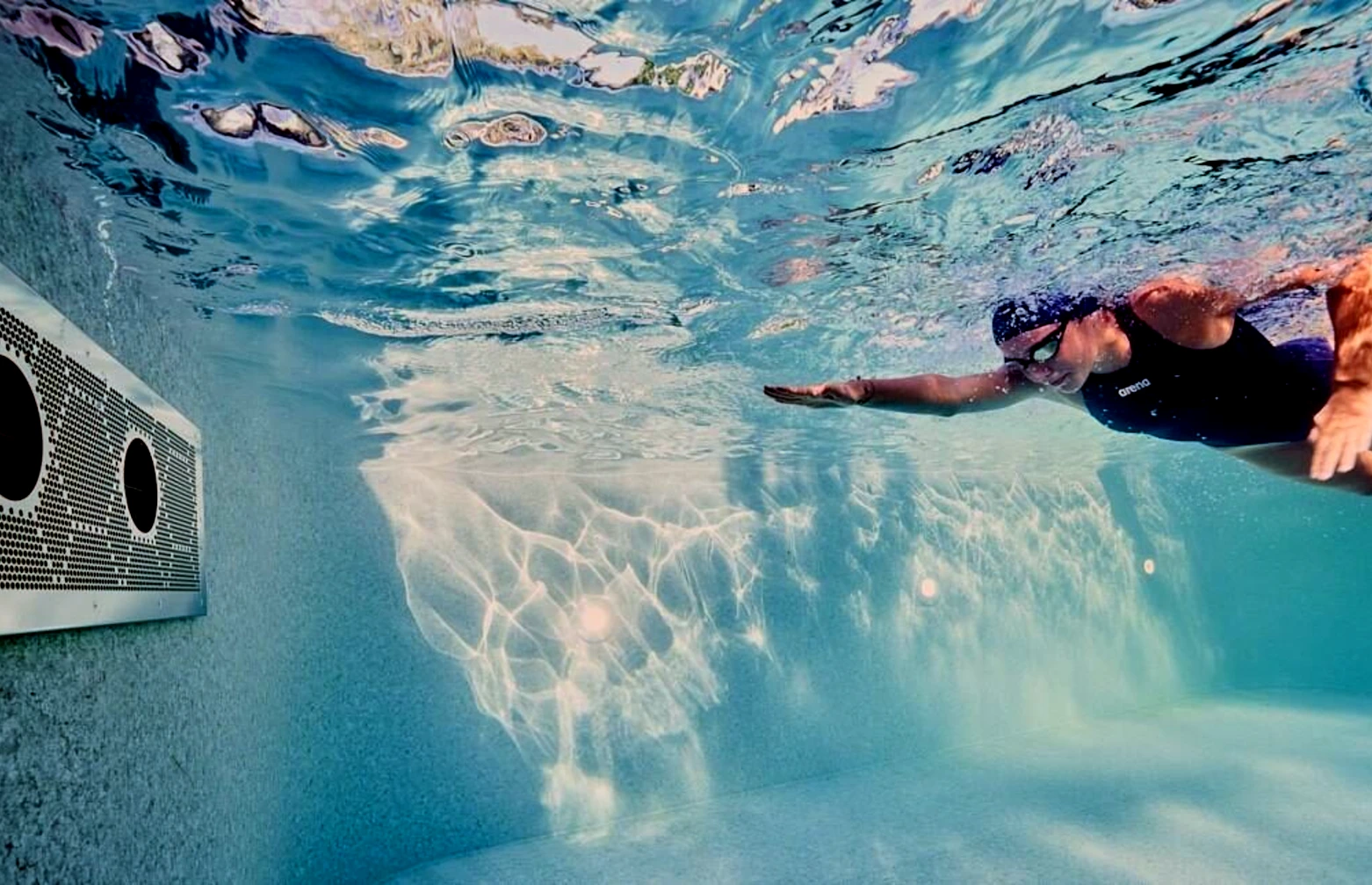
A counter current system pushes a flow of water along the pool, and the swimmer swims against it without moving forward. There are no turns and nothing holding you back, so the stroke stays natural, provided the current is wide and even. Narrow jets tend to push the legs down or to one side, which is the main difference between one system and another.
We supply EVA counter current swim systems, made in the Netherlands by EVA Optic, which use a turbine rather than jet nozzles and produce a broad, smooth current. EVA lists six built-in models, rated at swim paces of around 2 minutes 15 seconds per 100 metres at the gentle end and about 1 minute 5 seconds at the strongest. The speed is set from an app, so the same pool can give a slow recovery swim one day and a hard interval session the next. A built-in unit sits in a niche in the pool wall, so it is fitted to a new pool or during a pool refurbishment.
For a pool that already exists and is not being rebuilt, the battery-powered EVAstream Move is simply placed in the water. EVA gives a minimum pool size of 2.5 by 4.5 metres for the Move 225, which is smaller than many people expect. A plunge pool of that size can take one, so it is worth measuring before choosing a model. It runs on a battery that EVA rates at one to four hours, so it is charged between sessions rather than wired in.
Swim spas
A swim spa is a self-contained unit, larger than a hot tub, with its own current built in. It makes sense where there is no pool and space for one, or where heated water all year is the priority. It needs its own space and electrical supply, and a base strong enough to carry it when full.
Where there is already a pool, adding a current to it is usually the more sensible route, because the water and the filtration are already in place. We do not supply swim spas.
Which option suits you?
It depends on what you want from the water. For a few lengths and a cool-down on summer evenings, the pool as it is will do. For a structured session two or three times a week, a counter current system holds up best, because the session feels like continuous swimming. A heated pool lets it earn its keep in spring and autumn as well, which is where a heat pump comes in.
The World Health Organization's physical activity fact sheet (June 2024) uses at least 150 minutes of moderate-intensity activity a week as its benchmark for adults. Half an hour of steady swimming on five days a week meets it, and that is far easier to keep up when the swim feels like a swim.
A few practical points usually settle it. The first is who will swim and how often; the second is whether the pool is used outside the summer or let to guests who may want the water clear.
If you would like us to look at your pool and tell you honestly which option fits it, get in touch.