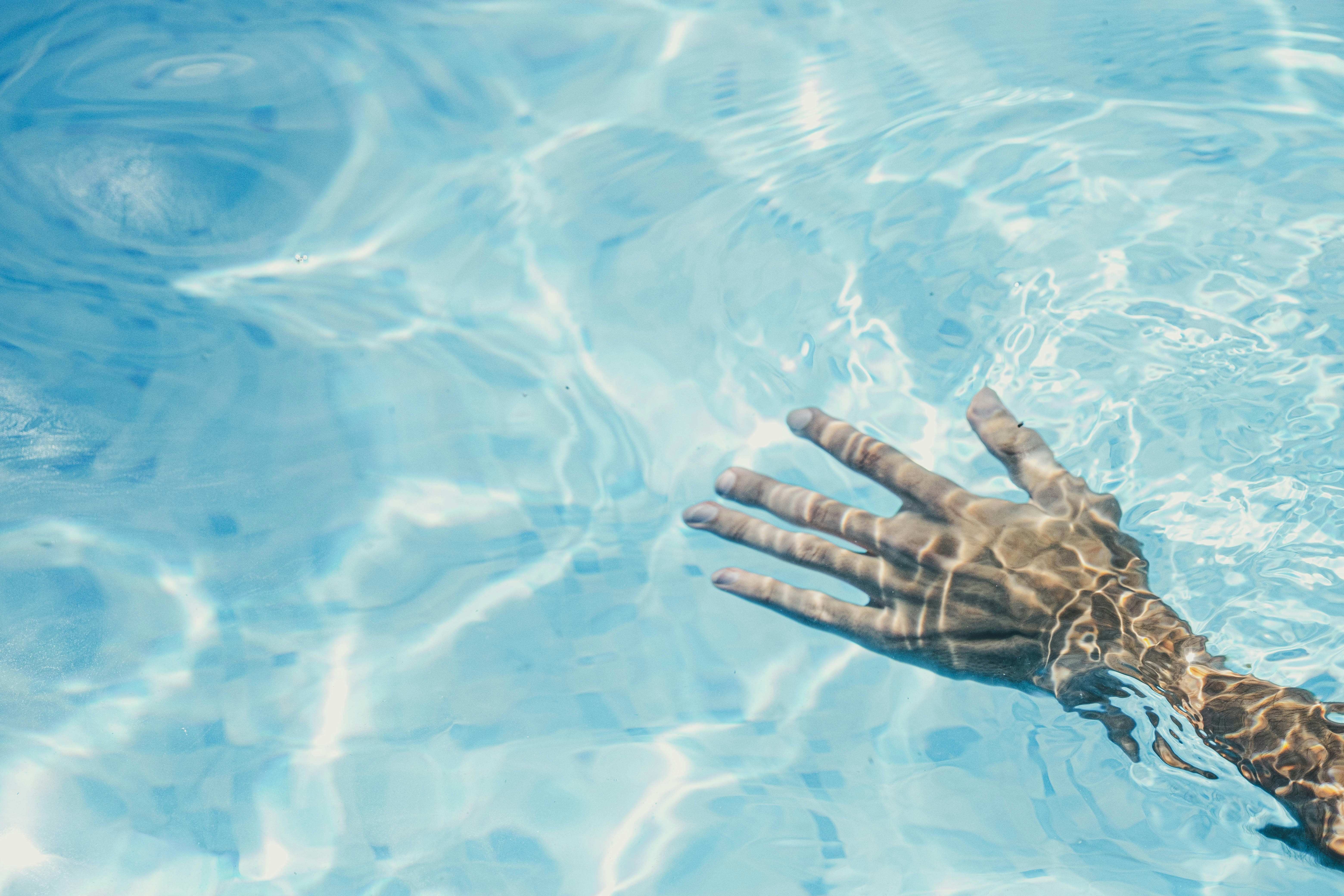
Why pool water irritates skin and eyes, and what to change in the water
Itching skin and red eyes after swimming are almost never caused by chlorine itself. They are caused by chloramines, which form when chlorine reacts with what swimmers bring into the water. A pool that smells strongly of chlorine has too little of it, not too much, and the fix is in the water chemistry rather than in a moisturiser.
Pool water skin irritation is usually blamed on chlorine, and the blame is misplaced. Itching, tightness, red eyes and the rash that appears under a swimming costume are caused by what chlorine turns into once it reacts with the things swimmers bring into the water. In eighteen years of testing water on properties across the region, the pools that produce complaints are almost never the heavily chlorinated ones.
The distinction matters because it changes the answer. If chlorine were the problem, the response would be to swim less or scrub harder. Since it is not, the response belongs in the plant room.
Why does pool water irritate skin?
Because of chloramines rather than chlorine. When free chlorine meets sweat, urine, skin cells, sun cream and cosmetics, it combines with the nitrogen in them and forms chloramines, which are the compounds that sting eyes and inflame skin. The US Centers for Disease Control and Prevention describes the same reaction as having two consequences: it creates those irritants, and it "decreases the amount of chlorine available to kill germs" (CDC, Healthy Swimming).
A swimmer reacting to a pool is therefore reacting to a by-product, not to the disinfectant. The same person will usually swim without symptoms in a pool where the chemistry is held properly, which is the clearest evidence that the water is the variable and not the skin.
What is the chlorine smell actually telling you?
That the pool has too little chlorine, not too much. The CDC puts it plainly: "If you smell chlorine at the place you swim, you are probably smelling chloramines." Free chlorine has almost no smell. The sharp odour associated with public pools and neglected private ones is the smell of chlorine that has already been used up by contaminants and converted into irritants.
This is worth knowing because it reverses the instinct most owners have. A guest complaining about the smell is not describing an over-dosed pool. They are describing a pool that needs more free chlorine, better circulation, or both.
The water figures that decide whether skin reacts
Three readings do most of the work. The Instituto Português da Qualidade recommends a pH between 7.2 and 7.6 for privately used pools, with free chlorine between 1.5 and 3.0 mg per litre when the pH sits in the upper part of that range. Those figures are the baseline, and water held outside them stings regardless of anything else.
pH deserves particular attention, because it sits close to the pH of tear fluid and skin. Water that has drifted to 8.0 will irritate eyes even when the chlorine reading is perfect, and it also cripples the chlorine that is there, since chlorine loses much of its disinfecting power as pH rises.
The third figure is stability, which is not a reading so much as a pattern. A pool dosed by hand twice a week spends most of its time either above or below target, and it is in the below periods that chloramines accumulate.
Is it swimmer's itch?
Almost certainly not, and the term is widely misused. Swimmer's itch, properly called cercarial dermatitis, is caused by the larvae of parasites released by freshwater snails, and it is contracted in lakes, reservoirs and slow rivers. The larvae do not survive in chlorinated water (CDC).
A rash that appears after swimming in a pool is chemical irritation. Calling it swimmer's itch sends people looking for the wrong cure, and it delays the thing that would actually fix it, which is a water test.
What actually reduces irritation in a private pool
Continuous dosing, because it removes the peaks and troughs that hand dosing creates. A salt chlorinator generates chlorine electrolytically from dissolved salt and produces it steadily, so the free chlorine residual stays where it should be while nobody is watching. The Sugar Valley units we fit pair that production with automatic pH regulation in one controller, which addresses two of the three figures above at the same time.
One point deserves stating clearly, because the industry is careless about it. A salt pool is a chlorine pool. The chlorinator makes the chlorine rather than delivering it from a container, and swimmers feel the difference because the dose is stable and because there is no periodic chemical shock, not because the water is chlorine free.
Filtration is the other half. Organic matter removed by the filter is organic matter that never gets the chance to react with chlorine, which is why a finer filter medium lowers chloramine formation as a side effect. Our filtration guide sets out how the media compare.
Where a pool is used heavily, or where the owner wants to go further, the Dryden Aqua DAISY system in our advanced water treatment range combines filtration, coagulation and oxidation so that free chlorine is needed only as a residual. Dryden Aqua describes the result as "pool water in drinking water quality, crystal clear and with no chlorine smell".
What the swimmer can do
Shower before getting in, which sounds counterintuitive and is not. Skin that is already saturated with clean water absorbs less pool water, and rinsing removes the sweat, sun cream and cosmetics that would otherwise become chloramines. This one habit reduces the irritant load for everyone in the pool, not only for the person doing it.
Rinse again on getting out, ideally within a few minutes, and moisturise while the skin is still damp. That is the whole of the useful skincare advice. If symptoms persist in a pool where the chemistry has been verified, the question belongs with a doctor rather than with a pool company.
Frequently asked questions
Am I allergic to chlorine?
True chlorine allergy is rare. What most swimmers describe as an allergy is irritation from chloramines, which form when chlorine reacts with sweat, urine, skin cells and cosmetics in the water. The same person will usually swim without symptoms in a well managed pool, which is the clearest sign that the water, not the swimmer, is the variable.
Does a strong chlorine smell mean the pool has too much chlorine?
No, it usually means the opposite. According to the CDC, the smell people identify as chlorine is chloramines, and chloramines form because free chlorine has been consumed by contaminants. A properly dosed pool smells of very little.
Is swimmer's itch caused by pool chemicals?
No. Swimmer's itch, or cercarial dermatitis, is caused by parasite larvae released by freshwater snails in lakes and reservoirs, and the larvae do not survive in a chlorinated pool. A rash from a swimming pool is chemical irritation, not swimmer's itch, and the two are often confused.
Is a salt water pool gentler on the skin than a chlorine pool?
A salt pool is a chlorine pool. The chlorinator makes chlorine from dissolved salt rather than delivering it from a container. Skin comfort improves because the dose is produced continuously and stays steady, so chloramines have less chance to build up, not because the water is chlorine free.
What pH should a pool be held at to avoid skin irritation?
The Instituto Português da Qualidade recommends a pH between 7.2 and 7.6 for privately used pools. That band sits close to the pH of tear fluid and skin, which is why water outside it stings even when chlorine levels are correct.
If your pool produces complaints and you would rather fix the cause than manage the symptoms, get in touch.