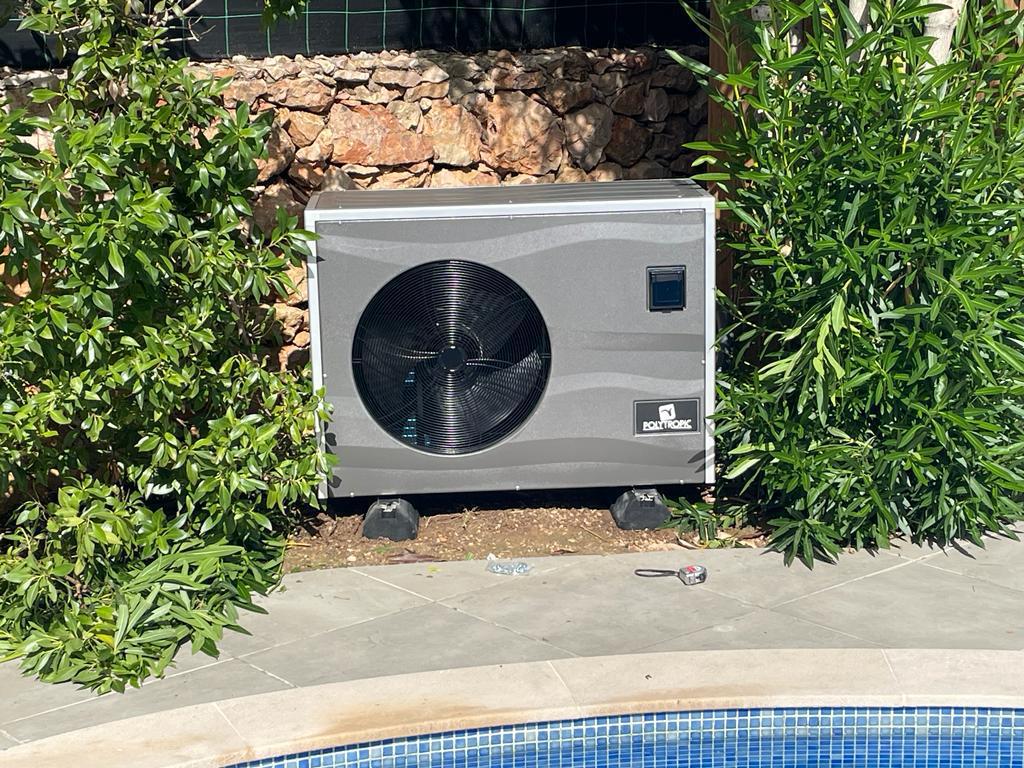
How a pool heat pump works, and what that means for a pool in the Algarve
A pool heat pump does not make heat, it moves it, which is why a good one returns several units of heat for every unit of electricity it draws. This explains the cycle in plain terms, why the COP figure on a brochure is measured under conditions you will rarely meet, and why the cover matters more to the running cost than the machine does.
A pool heat pump does not make heat. It moves heat that is already in the outside air and puts it into the water, which is the whole reason the machine returns more energy than it consumes. Every other question about pool heating, how much it costs to run, what size to buy, whether it works in winter, follows from that one fact.
We have specified and installed heating on pools across this region since 2008. What follows is how the machine actually works and which numbers are worth reading on a specification sheet.
How does a pool heat pump work?
A fan draws outside air across an evaporator containing a cold liquid refrigerant. The refrigerant absorbs heat from the air and boils into vapour. A compressor then squeezes that vapour, and because compressing a gas raises its temperature, the vapour leaves the compressor considerably hotter than the air it came from. A heat exchanger passes that heat into the pool water, the refrigerant condenses back to liquid, and the cycle repeats.
Nothing in that sequence generates heat. The electricity runs the fan and the compressor, and the heat itself comes from the air for free. That is why a pool heat pump delivers several units of heat for each unit of electricity, where an electric immersion heater can never deliver more than one.
What is COP, and why does the quoted figure mislead?
COP is the coefficient of performance, the ratio of heat delivered to electricity consumed. A COP of 5 means the unit puts five kilowatts of heat into the water for every kilowatt it draws from the supply. Higher is better, and the number is the single most useful figure on a specification sheet.
The catch is that COP is not a constant. It is measured at a stated air temperature, water temperature and humidity, and it changes as those change. A heat pump has more heat available to move on a warm humid afternoon than on a cold dry night, so the same machine will show a very different COP under the two conditions.
Manufacturers naturally publish figures measured under favourable conditions. The number itself is not dishonest, but it describes a day in June rather than an evening in March. When comparing two units, check that the conditions printed beneath the COP are the same before treating the figures as comparable. If one sheet states its conditions and the other does not, that difference tells you something too.
Does a heat pump work through an Algarve winter?
Yes, and the machine is rarely the constraint. The Polytropic Master Inverter range is specified to operate down to minus 15 degrees Celsius of air temperature, a figure the Algarve does not approach. In practical terms the unit spends the entire year inside the band it was designed for, which is not true of the same machine installed in northern Europe.
What limits winter heating here is the pool itself. An uncovered pool loses heat to the night sky by radiation and to the air by evaporation, and evaporation is the larger of the two. Heating an uncovered pool overnight is close to heating the garden. This is why we will not quote for a heat pump on a shoulder-season pool without discussing an automatic pool cover in the same conversation. The cover changes the running cost more than the choice of machine does.
Why an inverter rather than a fixed-speed unit?
A fixed-speed heat pump has two states, full power and off. It overshoots the target, stops, drifts down, and starts again, and every start draws a surge of current and makes noise. An inverter unit varies compressor speed instead, running slowly and continuously to hold the water where you set it.
The practical consequences are three: the water sits at a steadier temperature, the running cost across a month becomes predictable rather than lumpy, and the unit is far quieter because it spends most of its life at low speed. Every Polytropic unit we install uses full inverter technology.
What size does a pool need?
Sizing follows heat loss, and heat loss is governed mainly by surface area, exposure to wind and whether the pool is covered at night. Volume determines how long the first heat-up of the season takes. It does not determine what it costs to hold temperature afterwards, which is the cost that actually recurs.
This is why a number pulled from a chart is not a specification. Two pools of identical volume, one sheltered and covered, one exposed on a hillside and open, have completely different requirements. We visit and model the heat loss before quoting, because an oversized unit wastes money at purchase and an undersized one never reaches target on the nights you most wanted it to.
Noise, which matters more here than most people expect
Villas in the central Algarve sit closer together than the gardens they were modelled on, and plant rooms are often on a boundary wall. A heat pump that is inaudible in a catalogue can still be the reason a neighbour stops speaking to you.
The published figures are good. The Polytropic Ottimo runs at 19 decibels at ten metres in its quietest mode, and the Master Inverter range is published at 21 to 25 decibels at ten metres, with its sound levels validated by the independent French laboratory AlmaCoustic, measured to EN 17645:2022. Placement still decides the outcome, because a unit discharging towards a bedroom wall will be noticed whatever the sheet says.
What we install, and why
Three units cover almost every situation we meet. The Ottimo discharges air vertically rather than horizontally, which makes it the answer where the plant area is tight or hemmed in by walls. The Master Inverter covers the widest range of residential pool sizes and is the unit we specify most often. The RAK Inverter is built for volume, with up to fifteen units running from a single controller, which suits large or commercial installations.
All of them use R32 refrigerant, which carries a substantially lower global warming potential than the R410A it replaced, and all of them report through PolyConnect, so the unit can be monitored and adjusted from a phone. Details of the range are on our pool heat pumps page.
Portuguese law gives a three-year legal guarantee on movable goods under Decreto-Lei 84/2021, in force since January 2022, so the cover runs two years beyond the statutory minimum. That gap is the part worth reading, because a manufacturer willing to stand behind a machine for longer than the law obliges is telling you what it expects the machine to do.
Frequently asked questions
How does a pool heat pump work?
A fan draws outside air across an evaporator holding a cold refrigerant, which absorbs heat from the air and boils. A compressor raises the pressure of that vapour and its temperature with it, and a heat exchanger passes the heat into the pool water. The unit moves heat that already exists rather than generating it, which is why the heat delivered exceeds the electricity consumed.
What does COP mean on a pool heat pump?
COP is the coefficient of performance, the ratio of heat delivered to electricity consumed. A COP of 5 means five units of heat for one of electricity. The figure is always measured at stated air temperature, water temperature and humidity, so two COP values are only comparable when the conditions behind them are the same.
Does a pool heat pump work in winter?
In the Algarve, yes. The Polytropic Master Inverter range is specified to operate down to minus 15 degrees Celsius of air temperature, far below anything the region records, so the machine is never the limiting factor here. What limits winter heating is the pool's own heat loss to the night sky, which is why a cover matters more than extra kilowatts.
What size heat pump does my pool need?
Sizing follows heat loss, which is governed mainly by surface area, exposure to wind and whether the pool is covered at night. Volume matters for how long the first heat-up takes, not for what it costs to hold temperature afterwards. An oversized unit wastes money on purchase and an undersized one never reaches target on cold nights.
How noisy is a pool heat pump?
Modern inverter units are quiet. The Polytropic Ottimo runs at 19 decibels at ten metres in its quietest mode, and the Master Inverter range is published at 21 to 25 decibels at ten metres, with its sound levels validated by the independent French laboratory AlmaCoustic, measured to EN 17645:2022. Placement still matters, because a unit facing a neighbour's bedroom wall will be noticed whatever the specification says.
What warranty do the heat pumps carry?
Portuguese law sets a three-year legal guarantee on movable goods under Decreto-Lei 84/2021, in force since January 2022, so the manufacturer cover runs two years beyond the statutory minimum. Ask any supplier to state the warranty in writing and to say whether labour is included, because a parts-only warranty on a unit that needs an engineer to open it is worth considerably less than it sounds.
If you are weighing up heating for your pool and would rather have the heat loss modelled than guessed, get in touch.