How to Tell if Your Pool Is Losing Water: Signs, Tests and Electronic Leak Detection
Most pool owners investigate water loss last, after months of topping up. Some loss is normal: research in a climate close to the Algarve measured average evaporation at 4.4 litres per square metre per day. This explains how to tell a leak from evaporation with a bucket and an afternoon, and what an electronic survey does when the test says the water is going somewhere else.
A swimming pool losing water is a problem most owners investigate last, usually after months of topping up and a water bill that no longer makes sense. It deserves attention first. We operate the only electronic pool leak detection equipment in Portugal, and the pattern we see rarely varies: a level that keeps dropping, a hosepipe that has become part of the weekly routine, and a leak that has been running quietly for far longer than anyone thought. This article explains how to tell whether your pool is leaking, how to test it yourself in an afternoon, and what a professional survey involves when the answer is yes.
How can you tell if your pool is leaking?
The reliable signs are a water level that falls faster than evaporation explains, top-ups that have become routine rather than occasional, damp or subsiding paving around the pool, and chemical consumption that keeps rising because fresh water constantly dilutes the treatment. Any one of these justifies a proper check, and two or more make a leak very likely.
There are subtler signals too. Algae returning quickly after treatment suggests the water chemistry never stabilises, which constant dilution would explain. Air in the pump basket or bubbles returning to the pool can point to a suction-side pipe drawing air where it should be drawing water. A crack in the pool shell or loose tiles at the waterline sometimes marks the spot, though in our experience the visible damage and the actual leak are often in different places.
What is the bucket test and how do you do it?
The bucket test compares the pool's water loss against pure evaporation over 24 to 48 hours. Fill a bucket with pool water, stand it on the top step so it shares the pool's temperature and exposure, and mark both the bucket level and the pool level. If the pool falls noticeably further than the bucket, water is escaping somewhere.
Run the test twice if you can, once with the circulation pump on its normal schedule and once with it off. Faster loss with the pump running points towards the pressure-side pipework, while loss that continues at the same rate with everything off points towards the structure, a fitting or a suction line. Keep swimmers out and refill valves closed for the duration, or the result means nothing.
The bucket test tells you that a leak exists, and roughly which side of the system to suspect. It cannot tell you where the leak is, and digging or draining on a guess is the most expensive way to find out.
How much water does a pool leak actually waste?
Far more than evaporation, which is itself substantial in this climate. Research in the Balearic Islands, climatically very close to the Algarve, measured an average evaporation rate of 4.4 litres per square metre per day (Hof and colleagues, Water 10(12):1883, 2018). A leak losing just one millimetre of depth per hour from a 32 square metre pool wastes over 700 litres a day on top of that, more than 20,000 litres in a month.
The water is only part of the cost. Escaping water carries fines from beneath paving and terraces, and a leak left running can undermine the pool surround, the pump house or the structure itself. Treated, heated water also takes its chemicals and its warmth with it, so the losses appear on three bills at once. In a region where water restrictions return with every dry winter, a running leak is also simply indefensible.
How does electronic leak detection work?
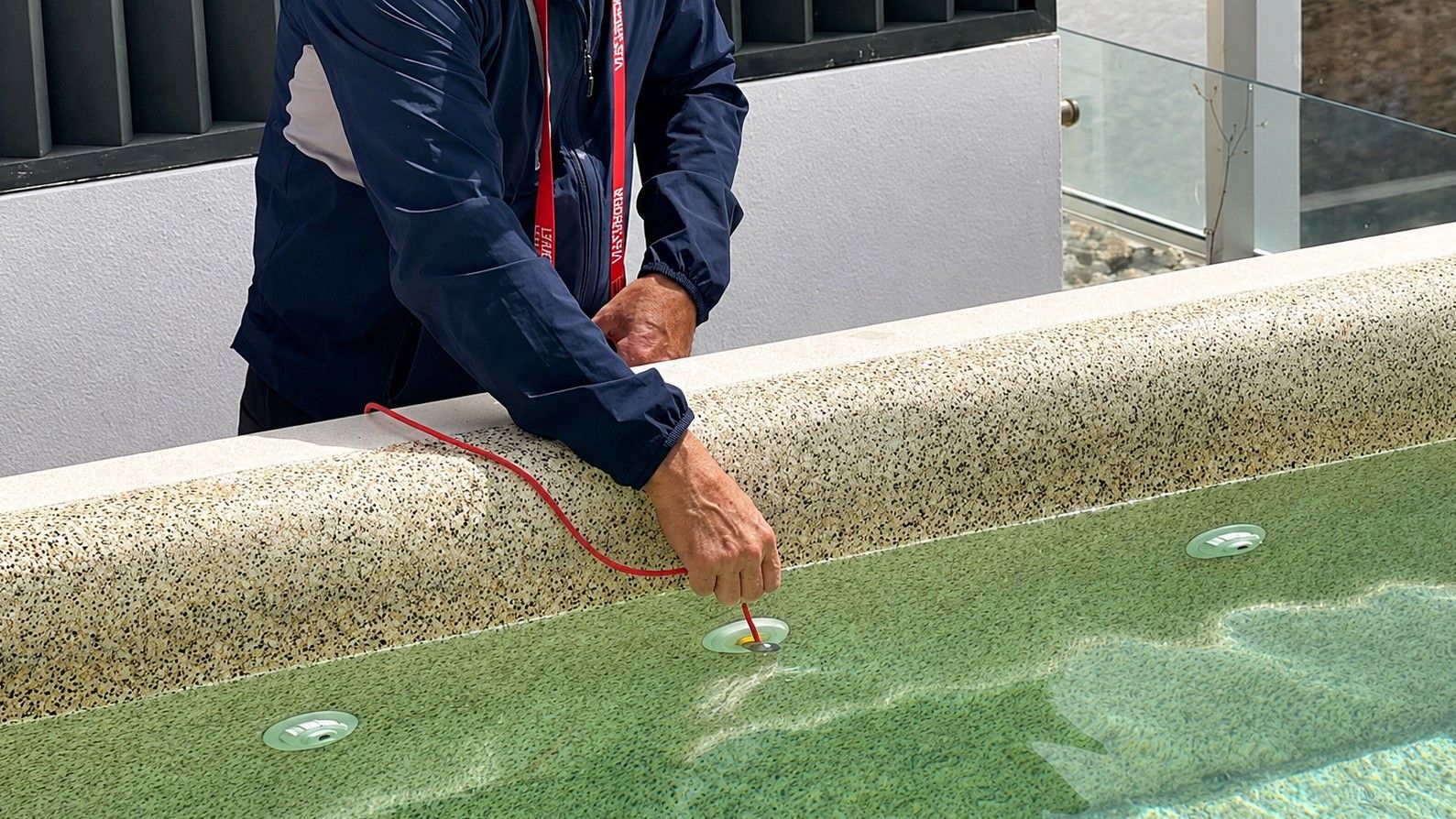
The survey tests the full system in a single visit, with the pool still full: skimmer seams, lights, main drains, the pool structure, and the underground pipework and fittings. Electronic listening and pressure equipment pinpoints the leak's location rather than the general area, with a 99 per cent success rate. Ours is the only equipment of its kind in Portugal.
The practical difference is precision. Traditional leak hunting means draining the pool, digging on suspicion, or replacing pipework wholesale in the hope of catching the fault. An electronic survey replaces that guesswork with a located fault: this fitting, this section of pipe, this point in the shell. The pool stays full throughout, which alone saves days of work and tens of thousands of litres of water. Full details are on our pool leak detection page.
What happens once the leak is found?
You receive the leak's precise location and a clear explanation of what is failing, which turns the repair from an excavation project into a targeted job. The excavation and the repair itself are carried out by your own builder. What that changes is the cost of the work, because nobody is being paid to search for something that has already been found.
Where the leak is structural, or where the pool's age means one repaired fault will soon have company, the sensible conversation is sometimes a broader one. Our pool refurbishment service rebuilds tired pools properly, and a detection survey is the honest way to establish whether a pool needs a repair or a renovation.
Afterwards, the best protection is knowing your pool's normal consumption. The INDYGO Pool Level system tops up automatically in controlled amounts and shows the pattern in the MyIndygo app, so a new fault announces itself as an abnormal call for water within days rather than months. Details are on our INDYGO Pool Level page.
What does Just Pools advise?
Trust the arithmetic, not impressions. Run the bucket test before assuming the worst, because summer evaporation surprises most owners, and an automatic pool cover will remove most of that ambiguity along with most of the loss. If the test shows more than evaporation, book a survey promptly, because every week of delay is thousands of litres and leaks do not repair themselves. We have surveyed pools across the region since 2008, and the cheapest leak we ever find is the one found early.
Frequently asked questions
Does the pool need to be drained for leak detection?
No. The electronic survey is carried out with the pool full, which protects the pool structure and saves tens of thousands of litres of water. Draining a pool on suspicion of a leak is unnecessary and, in drought-prone years, wasteful.
How long does a leak detection survey take?
The full system is tested in a single visit: skimmer seams, lights, main drains, the structure and the underground pipework. You are told what was found, and where, before we leave.
Is it normal for a pool to lose water in summer?
Some loss is normal. In a climate close to the Algarve's, evaporation from an uncovered pool averages around 4.4 litres per square metre per day and peaks well above that in July and August, according to Hof and colleagues writing in Water in 2018. Loss beyond that rate, confirmed by a bucket test, indicates a leak.
Does Just Pools repair the leak once it is found?
We locate the leak and mark its position precisely, and we explain what is failing. The excavation and the repair itself are carried out by your own builder or contractor. Repair work we undertake applies to equipment we supply and install.
Which areas does the service cover?
Leak detection surveys run throughout the Algarve. Equipment installation and repair extends from Vila Real de Santo Antonio to Sagres, and up to Lisbon and Ayamonte in Spain.
If your pool is losing water, get in touch.